
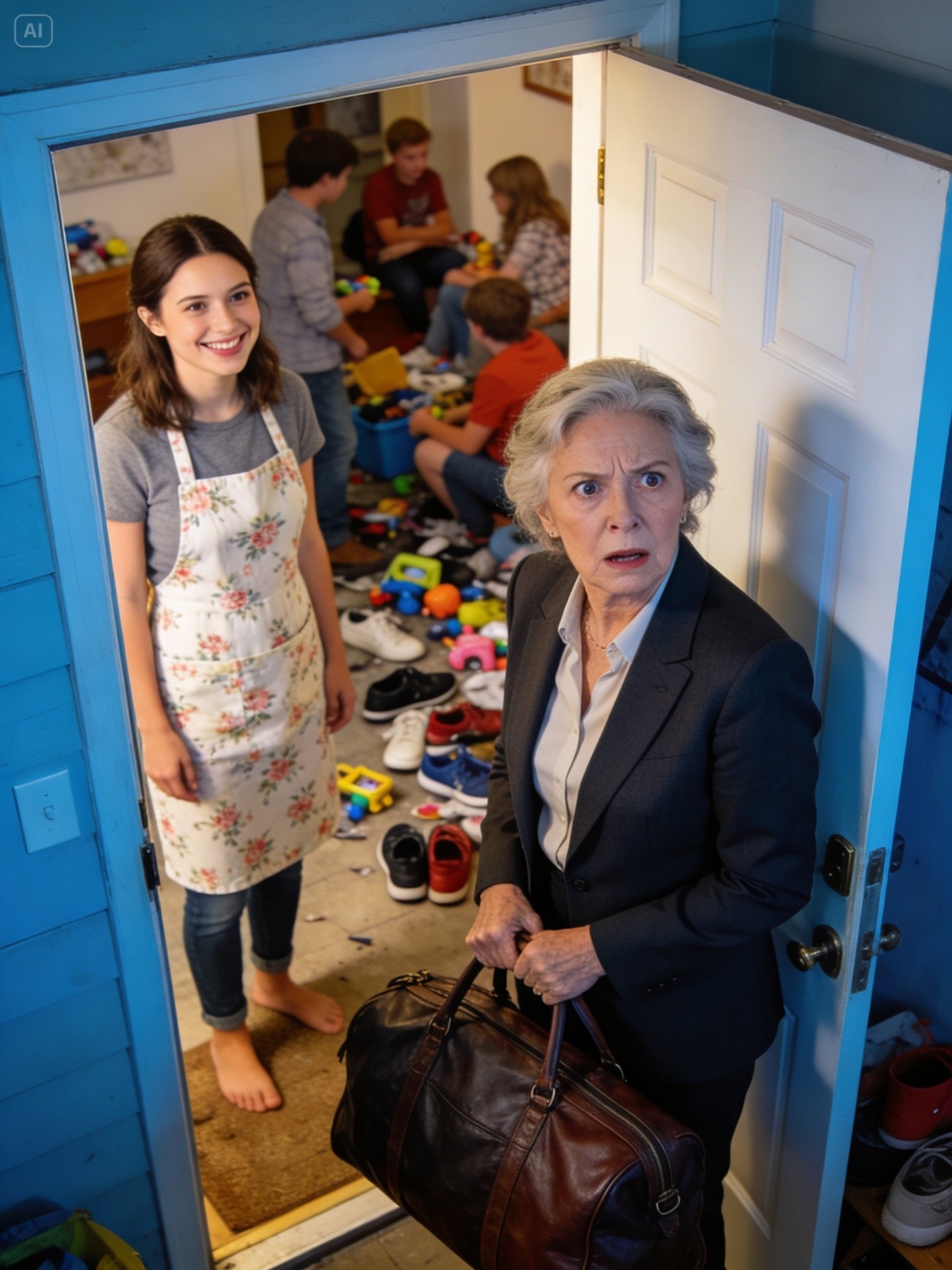
She arrived at her seaside home to rest, and her daughter-in-law greeted
There’s no room for you here anymore, Rosalind. The house is full, and we don’t want any inconvenience.”
That was the first thing Tiffany, my son’s wife, said to me when she opened the front door of my own house by the sea.
She did not whisper it. She did not even try to soften it with embarrassment. She stood there in the entryway wearing my embroidered apron, the cream one with the tiny blue flowers I had stitched by hand years earlier, and smiled the smile of a woman who had already decided the scene would go her way.
For one strange second, I honestly thought I had misheard her.
The January wind off the water was sharp enough to sting my cheeks. I had been driving since dawn from Philadelphia, my overnight bag still in one hand and my keys in the other, my back aching from too many hours behind the wheel. I had spent the last hundred miles imagining only two things: silence and sleep. Sleep in my own bed upstairs under the slanted ceiling, with the sound of the Atlantic moving beyond the dunes like slow breathing. Silence in the little reading corner by the bay window where Winston used to sit on rainy afternoons with the paper spread across his knees before cancer took the appetite from his body and the color from his hands.
That house was not a gift. Nobody gave it to me. Nobody handed me a key and said rest now, you’ve earned it. I built it the same way I built every secure thing in my life after widowhood: one small stubborn stitch at a time.
When Winston died, I was fifty years old and still had bills, grief, a teenage son, and a sewing machine that groaned every time I asked too much of it. I took alterations from anyone who asked. Wedding hems. School uniforms. Bridesmaid dresses bought in the wrong size. Torn winter coats. Broken zippers. Pants let out after babies or heartache or happy marriages softened people around the middle. I worked with cheap coffee at midnight and pins in my mouth and swollen fingers in February. I saved whatever was left after rent and groceries in an envelope I kept inside a flour tin over the refrigerator. I called it my little piece of air.
Twelve years later, that little piece of air became a half-rotted cottage on the Rhode Island coast with damp walls, cracked porch railings, sea salt in the window frames, and an overgrown garden everyone else in town thought was too far gone to bother with.
I bothered.
I painted walls until my shoulders burned. I ripped out moldy cupboards. I learned how to patch plaster from library books and YouTube videos and trial and error. I sanded floors myself. I changed locks. I planted hydrangeas and rosemary and a stubborn strip of lavender that survived two terrible winters simply because I refused to let it die. I made curtains from linen remnants. I stripped the old mantel and waxed it until the wood glowed again. I sewed cushions for the wicker chairs on the back terrace and stitched my initials into the hems because for the first time in my adult life I owned something that belonged only to me.
That house was my proof.
It was proof that even after death, exhaustion, disappointment, loneliness, and decades of being the one who managed on less, I could still make a haven with my own hands.
So when I turned onto my street that Friday afternoon and saw three unfamiliar SUVs lining the curb outside my gate, towels hanging over my wicker chairs, music thumping through my open front windows, and a plastic sand bucket tipped over in my herb bed, what I felt first was confusion.
Then anger.
Then something colder than anger.
The front door was already open. Children I did not recognize were racing across my back terrace with wet feet, shrieking while a half-deflated ball bounced off the railing beside my potted winter rosemary. My kitchen light was on. The television blared from the sitting room. Somebody had dragged one of my dining chairs onto the porch for no reason I could understand except laziness. The smell of frying oil and strong perfume poured out into the salt air.
Then Tiffany appeared.
She was thirty-five, polished in the overdone way she preferred, with a smooth dark bob, lip gloss too shiny for daylight, and that careful sweetness she used like a knife wrapped in velvet. She had one hand on the doorframe and my apron tied around her narrow waist like a costume.
“Oh,” she said brightly, as if I were a neighbor bringing over a casserole. “Mother-in-law. I thought you weren’t coming until February.”
“I told Peter I’d be here this Friday.”
She gave the smallest little shrug. “He must have forgotten. He’s swamped at work. But we’ve already settled in.”
Behind her, I could see deep into the house I had restored room by room with money earned under fluorescent lights and through tired wrists.
My blue throw pillows had been tossed onto the floor. A woman I recognized as Tiffany’s sister was stretched across my sofa with her shoes on, scrolling her phone. Tiffany’s mother was standing in my kitchen with both cabinet doors open, rifling around as if she had every right to examine my dishes. Two teenage boys thundered up the stairs barefoot. On the couch by the front window—my reading place, my favorite corner, the place where I drank tea and listened to storms—there was a baby asleep in a portable nest surrounded by bottles and burp cloths and someone else’s diaper bag.
I looked back at Tiffany.
“I told Peter I’d be here today,” I said again, more slowly this time.
She smiled, but her eyes did not.
“Well,” she said, “we’re here now. And honestly, there’s no room for extra guests.”
Extra guests.
In my own house.
It was such a perfect sentence that for a moment I almost admired its cruelty. She had prepared it. I could tell. She had rehearsed it somewhere in her head, perhaps while packing the SUVs, perhaps while tying on my apron and deciding how far she could push before anyone called her on it. It was not a slip. It was not panic. It was a message.
The most important part is just ahead — click NEXT »»
