
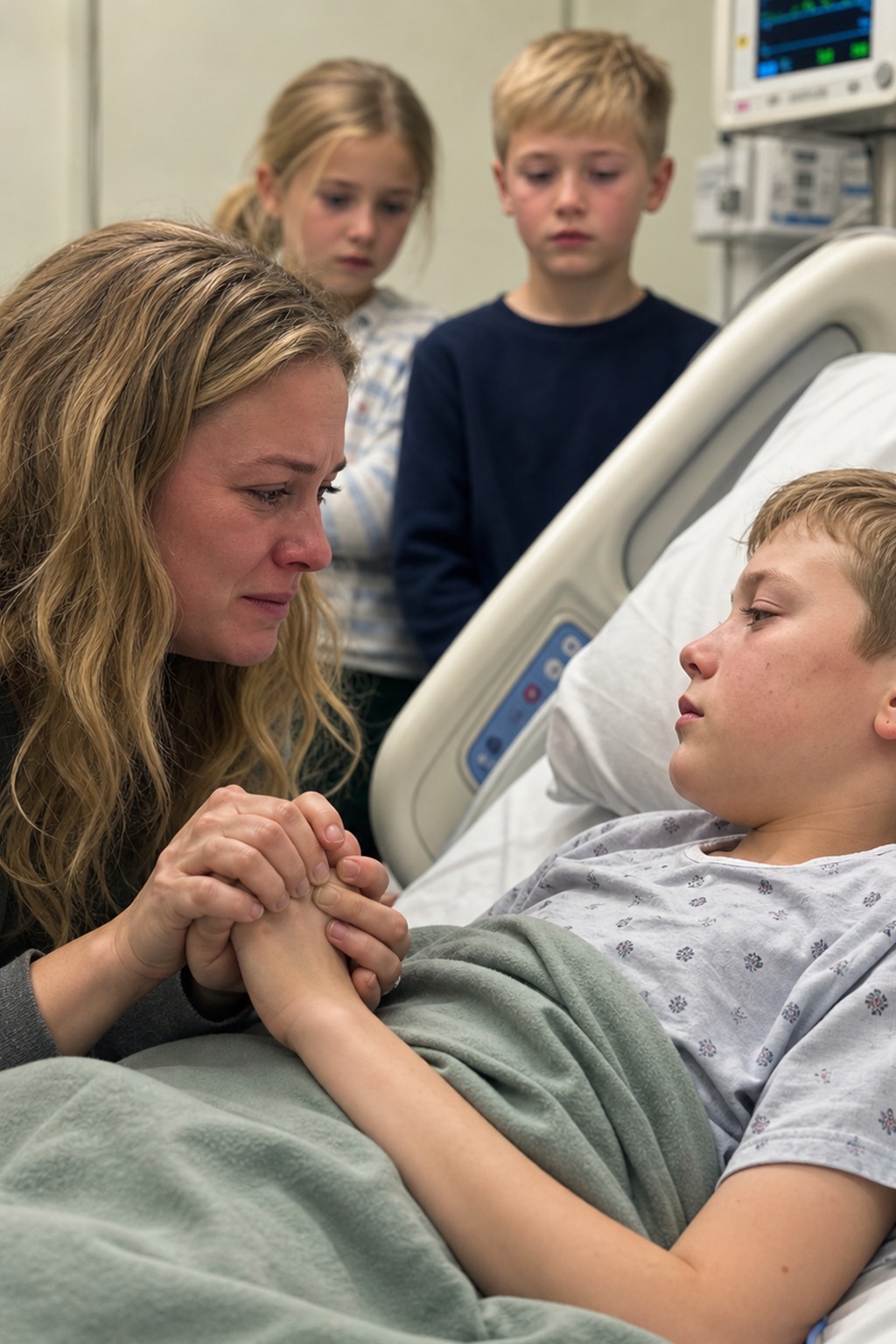
By evening, I had more than eighty missed calls.
Then came the texts.
Mom: Honey, we need you. It’s urgent. Please call back.
Dad: Call your mother right now. This is serious.
Lauren: Why aren’t you answering? We have a family emergency.
Michelle: Mom is freaking out. You need to respond.
James: This isn’t funny. Pick up the phone.
I remember staring at those messages and feeling nothing that resembled surprise. Of course. Of course this was the moment they became relentless. Of course urgency suddenly existed now. Of course family meant obligation again when the direction of need changed.
I did not answer.
Three days later, Ethan was discharged.
Bringing him home felt holy. He was weak, walking carefully, one arm looped around my shoulders and one around a pillow he insisted on carrying for comfort. The house smelled stale from being closed up for so long. I opened windows. I made up the couch with blankets and extra pillows because the bed was still too difficult for him to climb into and out of. I lined up his medications on the counter. I heated soup. I carried water glasses from room to room. I helped him to the bathroom in the middle of the night and kept track of antibiotic doses and temperature checks and how much he managed to eat.
The entire time, my phone remained a little machine full of demand.
By then the missed calls had crossed one hundred. I ignored them until the third evening after we got home, when Ethan finally fell into a deep, peaceful sleep in his own bed for the first time in over two weeks. The house was quiet. The kind of quiet that feels earned.
I sat on the couch and listened to the voicemails.
My mother’s voice first, increasingly frantic across several messages. “Honey, the mortgage payment bounced. The bank is calling. They said the automatic transfer was canceled. I don’t understand. Please call me. We can’t miss this payment.”
My father, sharper. “Your mother is upset. We need to talk about the house. Call back immediately.”
Lauren. “My car got repossessed this morning. They said the loan hasn’t been paid. What is going on? I need that car for work.”
Michelle, panicked and close to tears. “The hospital said the payment didn’t go through. They’re talking about delaying Mom’s next treatment until we settle the balance. Please call me. Please.”
James, furious. “My business account is frozen because the loan’s in default. I need to know what you did. Call me back now.”
I sat very still while message after message played, and there was a kind of terrible clarity in it. No one led with Ethan. No one asked whether he was all right before they launched into their crisis. No one said, “How are you holding up after two weeks in the hospital?” Their emergencies came first. Their panic was immediate. Their need was urgent. And the reason for all of it, the reason their carefully cushioned lives had suddenly lurched, was that I had finally stepped out from under the weight they had trained themselves not to notice.
I called my mother back.
She answered on the first ring, so fast it was obvious she had been staring at her phone waiting.
“Oh, thank God,” she said. “Honey, I don’t know what happened. The mortgage payment didn’t go through. The bank is threatening late penalties and—”
“I canceled it,” I said.
Silence.
A full, stunned silence.
Then, “What?”
“I canceled the automatic payment.”
There was a rustle, as if she had shifted the phone from one ear to the other, buying time for reality to rearrange itself into something she preferred. “Why would you do that?”
I leaned back against the couch and looked toward the hallway where Ethan slept.
“Because I’ve been paying your mortgage for five years, Mom. Eight hundred dollars a month. Forty-eight thousand dollars total. And when my son was in emergency surgery, when he had sepsis, when the doctors told me he might die, I texted you and asked you to come. I begged you to come. And no one came.”
“Oh,” she said, but it wasn’t a real word, only the sound a person makes when they’ve been forced against a truth they didn’t expect to hear out loud.
Then, too quickly, “I didn’t know it was that bad.”
I laughed, and the sound that came out of me was harsher than laughter should ever be. “I said he was critical.”
“Well, I—Lauren said—”
“That she had plans? Yes, I know what Lauren said.”
“Don’t twist my words,” my mother snapped, sounding offended now, as though we had somehow drifted into her grievance instead of mine. “I thought children recover quickly. I thought—”
“You thought what? That I was exaggerating? That ‘sepsis’ was me being dramatic? That ‘I need you’ was optional?”
She inhaled sharply. “You can’t just stop paying the mortgage. We could lose the house.”
And there it was. The center of it. Not Ethan. Not the hospital. Not the two weeks I spent alone while my son fought to live. The house.
I said quietly, “Ethan could have died.”
“That’s not fair.”
“No? He was in the ICU for eight days. I was there alone for two weeks. Nobody brought me a meal. Nobody sat with me for an hour. Nobody came to see him. But now you have an urgent need, and suddenly I’m supposed to be available.”
“It’s not the same.”
I sat up straighter, my voice turning cold in a way that surprised even me. “You’re right. It isn’t. This is a mortgage. Ethan is my child.”
I heard movement in the background, then my father’s voice, muffled at first and then louder: “What’s she saying?”
My mother must have covered the phone badly because I heard her answer. “She canceled the payment. She says she’s been paying it all this time.”
My father took the phone.
“You listen here,” he said, voice already rising into righteous anger. “We are family. Family helps each other.”
I closed my eyes for one second, not to calm myself but to savor how perfectly he had delivered the line that proved my point.
“You’re right, Dad,” I said. “Family helps each other. I’ve been helping for five years. Over two thousand dollars a month. More than one hundred twenty-eight thousand dollars in total. And when I needed help for the first time—for one ride, one meal, one hour in a waiting room, one visit to your grandson in intensive care—I got silence.”
The most important part is just ahead — click NEXT »»
