
And my sister had plans.
I called Michelle next. No answer. I called James. He declined the call, then texted two minutes later.
Stuck at work. Crazy deadline. Hope he’s okay.
Hope he’s okay.
Not I’m leaving now. Not keep me updated. Not I’ll come after work. Just hope he’s okay, the same tone you’d use if someone told you their kid had a stomach bug.
I stared at that text until the letters blurred.
That was the first moment something inside me shifted. Not fully. Not permanently. But a hairline crack formed in whatever unquestioning faith I still had left in the idea of my family as a place I could fall and still be caught.
The surgery lasted four hours.
People talk about waiting as if it is passive, but there is nothing passive about waiting to hear whether your child will survive. It is an act of endurance. It is physical. Your muscles ache from holding yourself together. Your jaw hurts from clenching. Time stops being measured in minutes and starts being measured in dread.
I watched families move around me in clusters. A woman arrived with a fast-food bag and handed fries to a teenage boy who looked like he hadn’t eaten all day. An auntie-looking grandmother in soft sneakers came bustling through with blankets. Two brothers took turns pacing while their spouses sat with an elderly parent. They touched each other’s shoulders. They brought coffee. They stood up when a doctor approached. They were there.
I sat alone with my phone faceup in my lap like it might suddenly decide to become a different device and deliver a different truth.
At 8:30, the surgeon came out, still masked, his cap damp at the edges. I knew before he spoke that this was not going to be simple relief. If it had been simple relief, he would have been smiling differently.
“The surgery itself went well,” he said. I almost collapsed from the partial mercy of that sentence. Then came the rest. “But the infection was more widespread than we’d hoped. He is very ill. He’ll be transferred to the pediatric ICU. We’re going to monitor him very closely for the next two days. He’s not out of danger yet.”
Not out of danger.
Those words took the small hope I’d begun to gather and forced me to hold it carefully, because it was still too fragile to trust.
A nurse led me upstairs to the pediatric ICU. The unit was colder than the rest of the hospital, or maybe it only felt that way because fear sharpens every discomfort into something memorable. Machines beeped softly behind curtains. There was a smell I would come to know too well over the next two weeks—sanitizer, plastic tubing, stale coffee, exhaustion.
When I saw Ethan, I stopped breathing for a second.
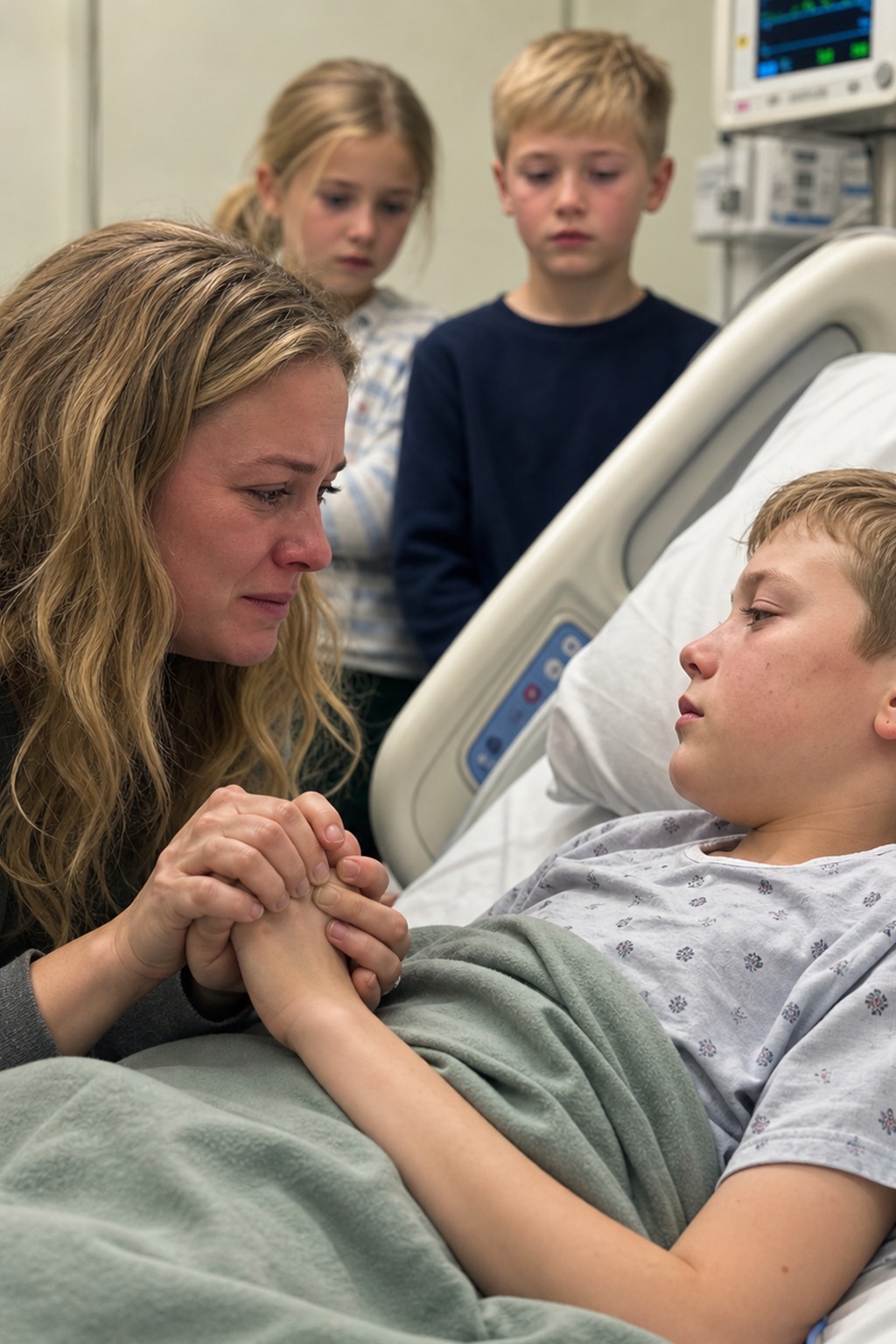
He was unconscious, his face pale against the white pillow, his body dwarfed by the bed and the machinery around it. Tubes. Wires. Monitors. A machine helping him breathe. His lashes lay dark against his cheeks like he was sleeping, except real sleep does not look like surrender. Real sleep does not make your child seem borrowed from you.
I pulled a chair to his bedside and sat down. Then I took his hand.
That became my place.
That chair, that room, that bedside, that small hand in mine.
That is where I stayed.
The ICU allowed one parent to remain in the room, and since Ethan’s father had not been part of our lives in any meaningful way since the divorce, there was no question who that would be. I slept in the room. If you can call it sleep. Mostly it was drifting in and out with my head against the wall or folded on my arms while monitors chirped and nurses came in at all hours to check vitals, adjust medications, empty drains, change dressings, murmur numbers to each other.
I left only to use the bathroom, shower in a family lounge on the third floor, or run downstairs for cafeteria food when I realized I was shaking from hunger. I had three changes of clothes in my emergency car bag—one of those practical habits I’d formed as a single mother who liked being prepared. That bag ended up being all I had. Day after day I rotated the same leggings, the same cardigan, the same T-shirt, washing things in a sink when I had to, hanging them on the back of a chair to dry.
The most important part is just ahead — click NEXT »»
