
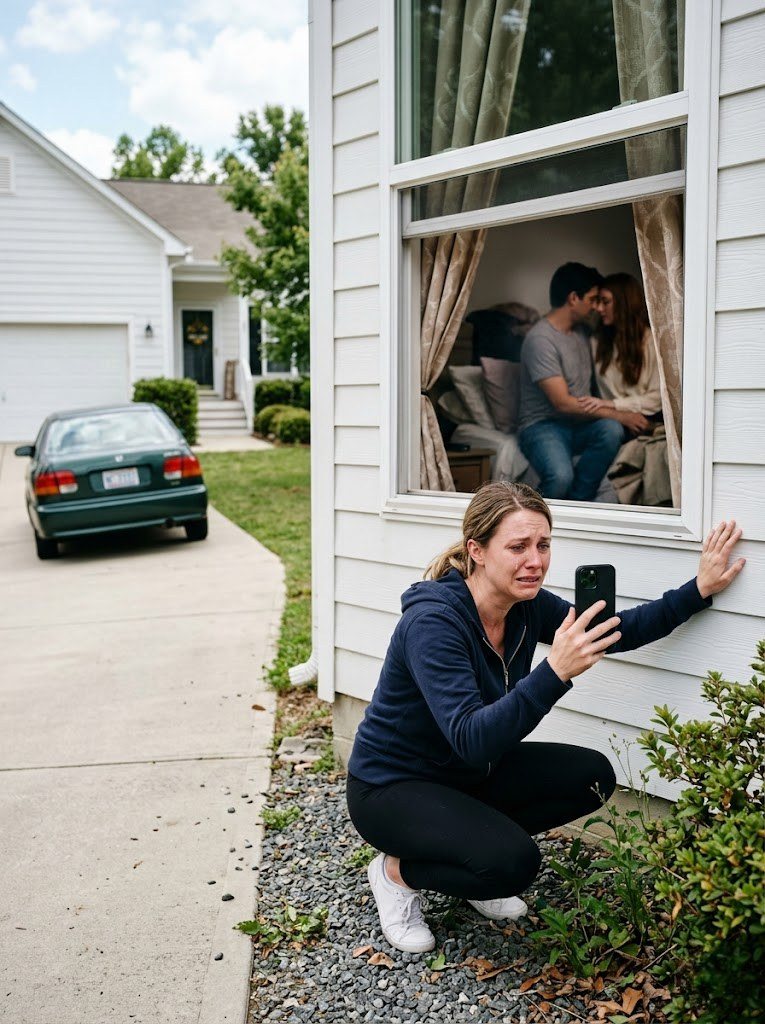
Lauren said that was normal.
She was right.
I did not miss Marcus in the way people assumed. I missed the version of my life that had not been contaminated yet. I missed certainty. I missed feeling stupid only in harmless ways.
About four months later, I got careless.
Not emotionally.
Logistically.
I had settled into routines, the kind that make you think danger has gotten bored and moved on. Same coffee shop near work twice a week, same table if it was open, same blueberry muffin I kept pretending I would stop ordering because it tasted like sugar wearing a disguise. I had not seen Marcus in months. I had stopped imagining him around every corner.
That was my mistake.
I walked into the coffee shop on a Thursday and saw him near the window.
My first thought was not fear or anger.
It was calculation.
He had not been there before. Not once in the three months I had been coming there. That meant either this was a miserable coincidence or he had figured out my pattern.
Neither option made me feel safe.
I stopped mid-step hard enough for the woman behind me to bump my shoulder.
Marcus stood immediately. Not rushing toward me. Just enough to signal intent. He looked thinner, tired, not ruined, not broken, not dramatically transformed by guilt in some satisfying way. Just worn around the edges, which annoyingly made him look more sympathetic.
Men have an unfair relationship with damage. They get one good week of bad sleep, and suddenly they look like poems to people who should know better.
“I’m not here to cause a scene,” he said.
I laughed once.
“That’s generous.”
He asked if we could sit for five minutes.
I should have walked out. I know that. But part of me wanted to hear what kind of nonsense could survive four months in his head and still come out dressed as explanation. Also, if I am being honest, there was ego in it. Curiosity. The almost anthropological urge to study the creature that thought I might still be available for conversation after everything.
So I sat.
I kept my bag on my lap like I was prepared to flee a minor fire.
He noticed.
Good.
He started talking too fast, the way people do when they know they have a narrow window and a terrible case. He said he was not there to pressure me. He said he just needed me to hear the truth from him once, which was funny because I had, in a way, through a partially closed curtain.
According to Marcus, it had not been an emotional affair. Not a relationship. Not ongoing in the serious sense. It was physical, he said. Isolated. Stupid. Meaningless. A woman he knew through freelance work. Someone with a “reputation for discreet situations.”
I did not ask her name.
I did not want it.
Knowing who she was would not change what he had done. She was not the person who had promised me forever. He was. She owed me nothing. He owed me everything.
He used that phrase—discreet situations—like he was discussing weather patterns instead of admitting he had been sleeping around in the lead-up to our wedding.
He said he had gotten in his head about marriage, permanence, choosing one person forever. He said he panicked and wanted to get “curiosity out of his system” before the wedding.
That phrase was so rotten and selfish I felt the air go thin around me. Not because it shocked me by then, but because he still expected language like curiosity to make it smaller, like what he had done was a pathetic bachelor impulse instead of deliberate betrayal.
I let him talk.
That was probably my mistake.
Silence encourages men like him. They start mistaking your restraint for openness.
He said he never stopped loving me. Said it was never about replacing me. Said the wedding was real to him. Said he planned to end it and commit fully and bury the whole thing.
Which, wow.
How lucky I was almost allowed to marry into a secret cleanup operation.
When I finally spoke, my voice surprised even me.
Calm. Flat.
“So your defense is that you intended to lie forever?”
He flinched. Only for a second.
“No. My defense is that it was ugly and stupid and didn’t mean what it looked like.”
That sentence sat between us like spoiled milk.
“Was it only once?” I asked.
He hesitated.
Tiny pause.
That was answer enough.
I smiled without joy and looked down at my coffee, because apparently, even then, part of me preferred my humiliation in manageable servings.
He said my name in that soft tone he used when he wanted me to reenter a dynamic where he explained and I softened.
I cut him off.
“Don’t talk to me like I’m still your person.”
His eyes did that wounded thing. I hated that too because hurt can be real even in guilty people, and seeing it can trigger old habits: comforting, clarifying, taking responsibility for the emotional temperature in the room.
I had done that for years without calling it what it was.
Not this time.
He said he was trying to take responsibility.
I said, “No, you’re trying to survive your own image of yourself.”
That shut him up.
For a moment.
Then he pivoted. I should have expected it. He said I could have confronted him privately. I could have come inside that day. I could have called him before canceling the wedding. He did not say it angrily at first. He said it sadly, as if mourning my lost opportunity to behave better around his betrayal.
“You didn’t have to destroy everything,” he said.
I laughed.
Not because it was funny.
Because the nerve of that sentence deserved sound.
“You destroyed it,” I said. “I just refused to help you hide it.”
He rubbed his face. Then came the next pivot.
His parents.
How devastated they had been. How humiliating the venue scene was for them. How his father had to cover costs.
The most important part is just ahead — click NEXT »»
