
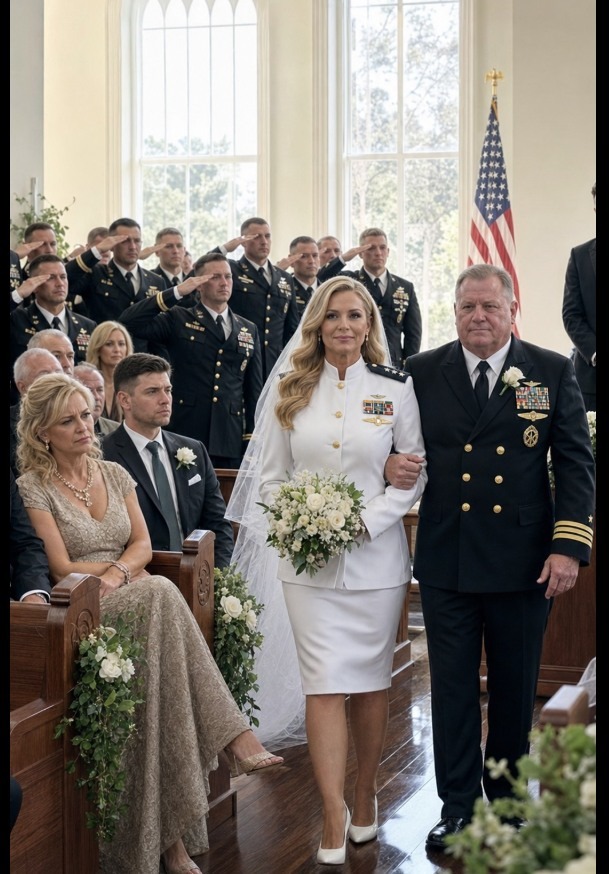
I carried my mother’s letter.
Not because I needed to read it.
Because I wanted to leave something.
At the edge of the water, I unfolded a copy of the first page.
Not the original.
Never the original.
I read the opening line one more time.
If you are holding this letter on your wedding day, then your father has done what I feared he would do.
I folded it carefully.
Nathan watched me.
“You sure?”
“Yes.”
I placed the copy into a small glass bottle and set it in the water.
The tide took it slowly.
A private burial for an old grief.
Nathan slid his arm around my waist.
“What now, Admiral?”
I looked at the ocean.
“For once? Nothing.”
He smiled.
“Ambitious.”
“I’m known for impossible operations.”
He laughed.
Then my phone buzzed.
Patrick.
I almost ignored it.
Then I opened the message.
It was a photograph.
My brother standing beside the white rose chair from my wedding. He had apparently gone to the chapel that morning.
Under it, he wrote:
I stood today. Late, but I stood.
I looked at the photo for a long time.
Then I typed back:
Keep standing.
It was not forgiveness.
Not yet.
But it was not silence either.
Two years later, the Kane-Ellison Foundation launched the Elaine Kane Witness Scholarship for daughters of military families whose service had been dismissed, discouraged, or denied by their own households.
The first ceremony took place in Monterey.
At my mother’s house.
My house now.
The garden overlooked the water. White chairs lined the lawn. Young women stood in uniforms from different branches, some with parents beside them, some without.
One cadet approached me afterward.
Her father had refused to attend.
“He says the Air Force made me arrogant,” she said, trying to smile.
I looked at her shoulders.
So young.
So determined.
So familiar.
“No,” I said. “It gave your courage structure.”
Her eyes filled.
I handed her the scholarship envelope.
“And for the record, we stood for you today.”
She cried then.
So did her mother.
So did I, later, privately, where admirals are allowed to be human without alarming junior officers.
Admiral Grayson attended in a wheelchair that year.
He complained loudly about the slope of my garden and called Nathan “doctor boy” with affection he pretended was annoyance.
At the end of the ceremony, he took my hand.
“Elaine would like this,” he said.
“You think?”
“I know.”
He looked out at the cadets.
“She told me once that your father wanted a family portrait where everyone knew their place.”
I smiled faintly.
“That sounds like him.”
“She said you were the one who kept stepping out of frame.”
The most important part is just ahead — click NEXT »»
