
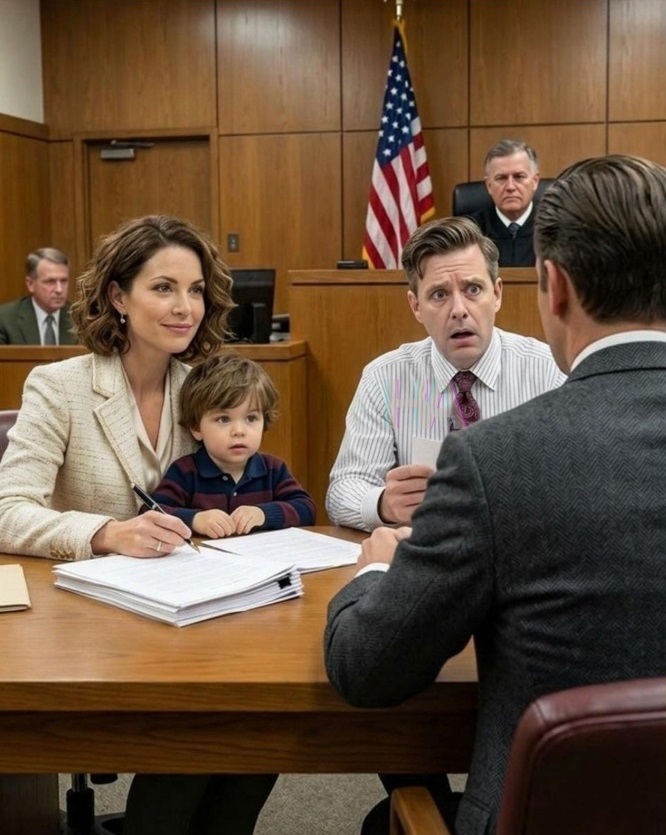
That surprised you. Brian had always worn confidence like insulation. Apparently, dependency and embarrassment burn calories.
“You could hire me back in a different role,” he said after five minutes of circling. “Consulting. Development strategy. I know the market better than any of these people.”
Any of these people.
Meaning the team carrying his old company on their backs while he was busy imagining himself irreplaceable.
You folded your hands on the table. “I already have a development strategy lead.”
He blinked. “Who?”
“You’re speaking to her.”
That did it.
He stared at you, and for one naked moment all the old scripts failed him. No charm. No condescension. No marital shorthand. Just a man finally forced to see the woman he had treated like emotional wallpaper standing in front of him as the center of a room he could no longer control.
“You’ve changed,” he said.
You thought about that.
About the woman who used to explain his lateness to Mason with gentle lies.
Who used to host client dinners while knowing he texted Tessa from the pantry.
Who used to minimize her own intelligence because being obviously smarter made Brian brittle.
Who once believed fairness required over-articulating her pain to men determined not to understand it.
“Yes,” you said. “I got tired of making myself smaller so you could feel taller.”
He looked away first.
Mason changed too.
Not quickly. Children do not heal on adult timelines. He spent the first six months after the divorce asking logistical questions in emotional clothing. Where does Dad sleep now? Why does he miss soccer if he says he misses me? Why do grown-ups say things are complicated when they really mean somebody was selfish? You answered as honestly as his age could hold. Dana, unexpectedly maternal under the shark polish, recommended a child therapist in McLean who used Lego cities and baseball metaphors to help boys rebuild after emotional weather.
It helped.
So did routine. Pancakes on Saturdays. Homework at the kitchen table. Bedtime reading no matter what. A smaller townhouse in Falls Church with a backyard just big enough for a net and a dog Mason begged for until you finally caved. The dog, a rescue mutt with one bent ear and zero respect for personal space, became one of those creatures that enter a family exactly when something needs stabilizing.
Mason named him Slider.
Margaret, Brian’s mother, continued to surprise everyone.
After the hearing, she called you privately and asked to see Mason. Not Brian. Mason. She arrived at the park in loafers too nice for mulch and carrying a paper bag full of baseball cards she found in Brian’s old childhood closet. She sat on the bench while Mason showed her how Slider could almost fetch if the mood aligned with the object, and at one point she said, without looking at you, “I raised a man with excellent posture and weak character. I don’t intend to lose my grandson because of it.”
That was the closest thing to an apology you expected from her.
It was enough.
She became, over time, one of the more reliable people in Mason’s life. Not warm in the motherly sense. More like a judge who had decided one child in the bloodline deserved actual consistency. She took him to science museums, taught him how to write thank-you notes with weaponized precision, and once told Brian in your presence, “If you can’t be admirable, at least try for punctual.”
You nearly choked on iced tea.
As for Tessa, she lasted less than a year.
You learned that not from gossip, though there was plenty. Arlington and D.C. suburbia breed polished rumor the way summer breeds mosquitoes. No, you learned it because Brian emailed you one evening with a subject line that read simply:
About Mason’s school recital
The recital question took up one sentence.
The rest was apology by collateral.
He said Tessa had “not turned out to be the sort of person he thought she was,” which would have been funny if it weren’t so predictable. Men like Brian are forever shocked when women who participated in deception turn out not to be built for loyal domestic sainthood. He mentioned finances too, indirectly. The house was on the market. The cars were more expensive to maintain than he expected. Consulting gigs were inconsistent. The settlement had looked like triumph until actual cash flow exposed it as costume jewelry.
You read the email once and then deleted it.
Because by then, you knew something essential.
The opposite of being destroyed is not revenge.
It is indifference with good boundaries.
The most important part is just ahead — click NEXT »»
